Bring us one use case
Thirty minutes. We assess its potential, identify the required integrations and outline a realistic path to a proof of concept.
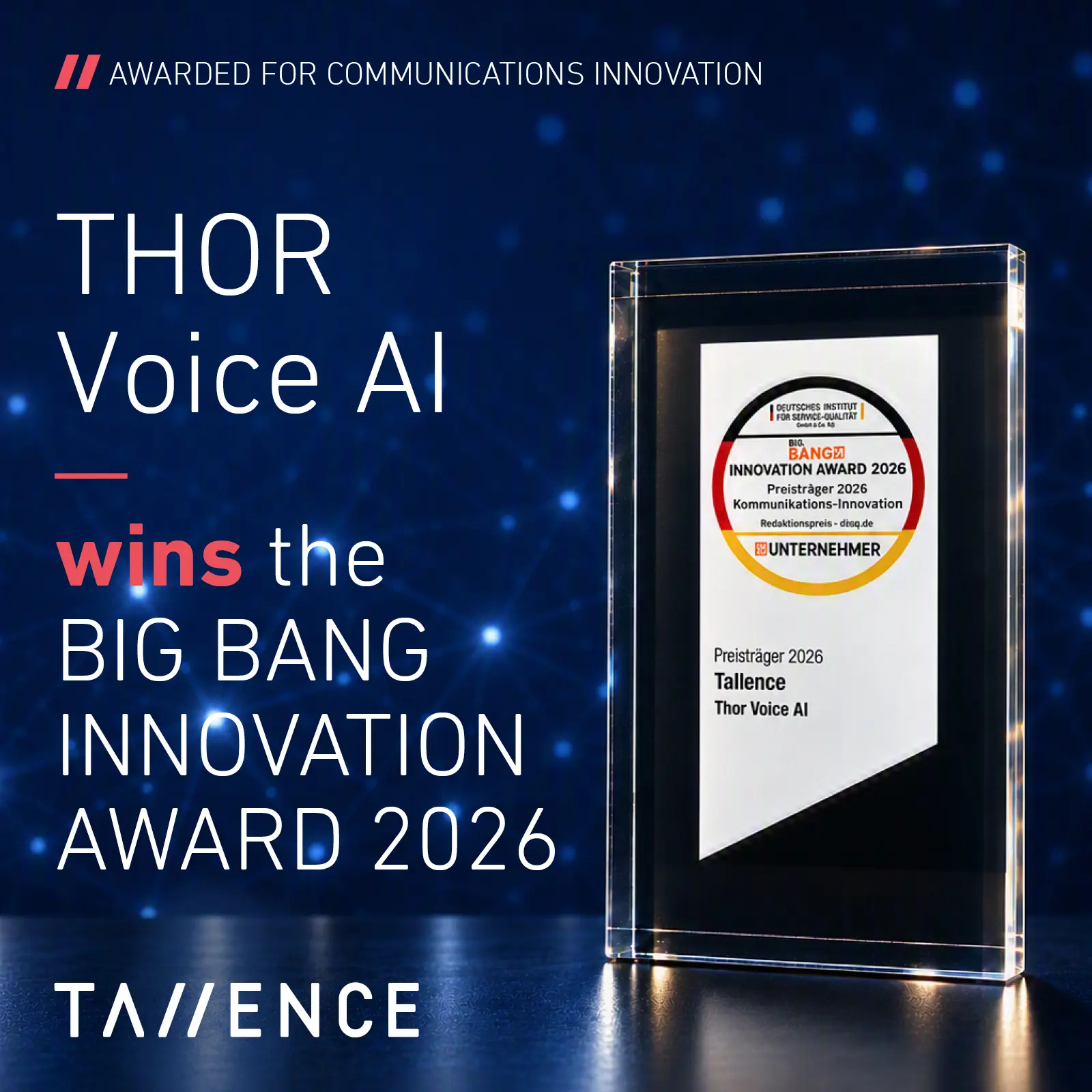
Most voice AI never makes it out of the demo. It works on a stage, then meets an IMS environment, a charging system and a regulator, and stops. THOR Voice AI was built for the other direction. It runs inside the operator network as a service layer, not alongside it as an app. That approach has now been recognised: Tallence received the BIG BANG INNOVATION Award 2026 for THOR Voice AI, in the Kommunikations-Innovation category of the DUP Editorial Award, presented by the German Institute for Service Quality (DISQ) and DUP UNTERNEHMER at the BIG BANG KI Festival in Berlin.
THOR is not a CPaaS. It is not an app framework. It is a telco-grade execution layer, embedded in the network.
That distinction decides who owns the customer relationship. An over-the-top assistant sits on top of the call and takes the data, the identity and the billing relationship with it. A network-native service layer keeps all three where they already are.
THOR connects with existing telecommunications infrastructure, including IMS, BSS and OSS, CRM and real-time charging environments. It operates as an originating or terminating service, B2BUA, User Agent or transparent proxy, and works with leading Media Resource Functions. Operators retain control over activation logic, identity, data governance, service policies and monetisation.
THOR Voice AI is a platform, not a product catalogue. Whatever is technically possible with voice AI today can be built on it. The following are examples, not the scope.
Services run through the existing phone number and within customers' familiar telephony experience. No new app, no new device, and no change to user behavior.
Operators hold what app-based providers have to buy or fake: network reach, trusted customer relationships, verified identity, quality of service and established charging capabilities.
THOR brings those assets together with real-time AI through four functions. Orchestrate runs deterministic workflows, so business-critical voice services behave predictably rather than probabilistically. Integrate brings AI models in underpolicy control. Enforce applies operator-defined guardrails and governance across the whole workflow. Connect ties the service into network infrastructure and business systems.
Deterministic execution is the part that matters in regulated environments. A service that escalates a support case or triggers a charge cannot improvise.

„Voice AI only becomes relevant for operators when it moves beyond a promising demonstration and runs reliably within existing network and business environments. THOR Voice AI was designed to make exactly that transition possible.”
Martin Rückert, Chief AI Officer, Tallence AG
The platform supports a modular path. Operators start with one clearly defined use case, validate its technical and commercial potential, then integrate it into network and business systems.
None of this is theoretical. THOR Voice AI is currently being piloted with a leading European operator. Live transcription and translation run in English, German, French, Spanish and Portuguese, with more on the roadmap.
The commercial model follows the same logic as the architecture, and it has two parts.
Operators pay for capacity: the maximum number of concurrent sessions they want available, not the number of words spoken. That prevents margins from eroding with usage the way they did on data.
On top of that, Tallence participates in what the operator actually bills its own customers, whether that is charging events, minutes or any other unit the operator monetises. Tallence earns when the operator earns.
Operators do not need a platform decision to start. They need one use case, one integration map and one honest assessment of whether the commercial case holds. That is what a proof of concept is for.
The BIG BANG INNOVATION Award recognises the work of the Tallence teams combining telecommunications engineering, integration expertise and applied AI. More importantly, it marks the point where voice AI stops being a concept and becomes a controlled, scalable and commercially viable service.

// Contact
Martin Rückert
Thirty minutes. We assess its potential, identify the required integrations and outline a realistic path to a proof of concept.