Please note that this blog post was originally published on telcotitans.com.
Chief Data Officer
DT and Vodafone automate identity management for sovereign-ready network compliance
Highlights // Tallence Editorial Team // Sep 1, 2026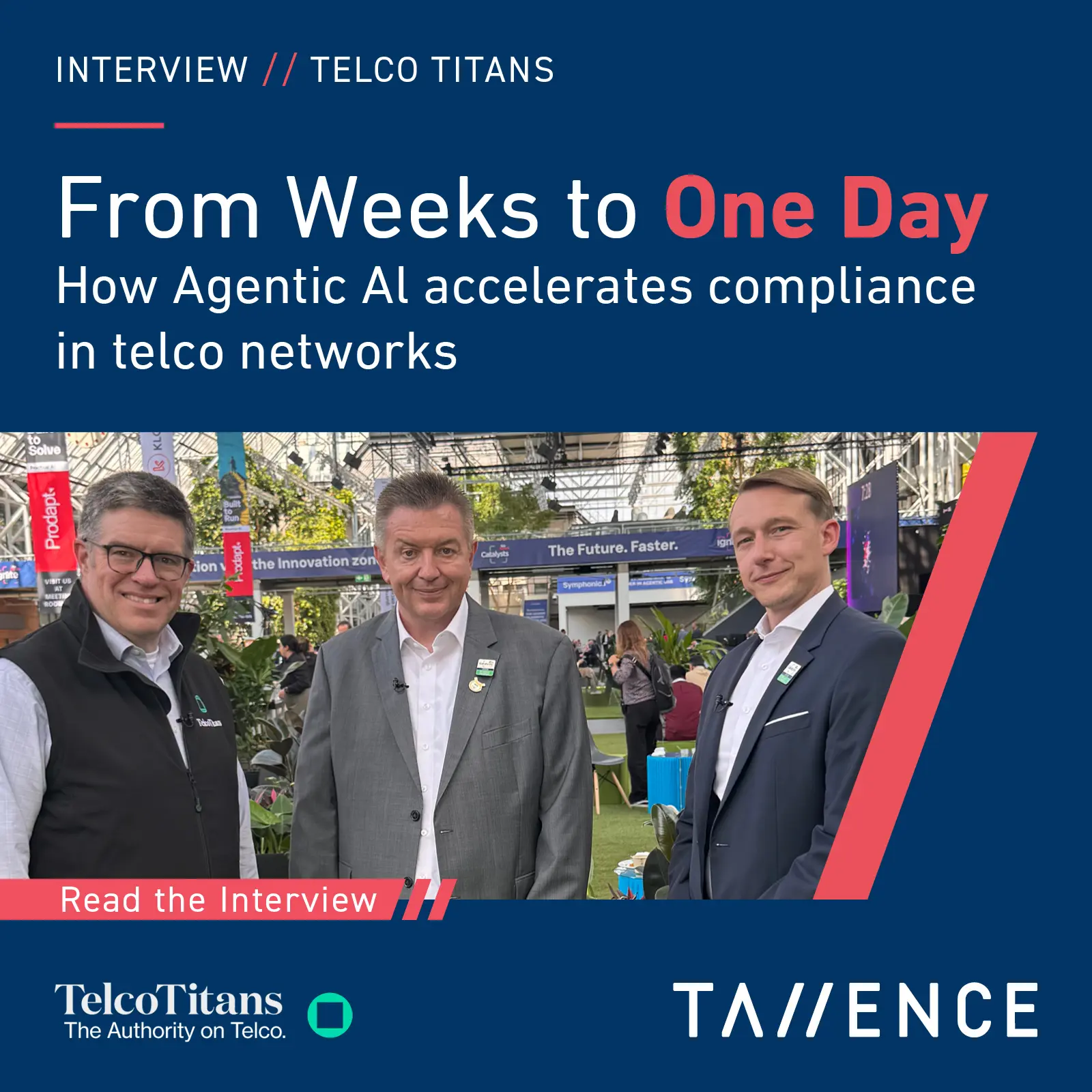
For telecom operators, regulatory change becomes an operational challenge when complex requirements have to be translated into secure, auditable access policies across the network. A TM Forum Catalyst championed by Deutsche Telekom and Vodafone demonstrates how agentic AI and Digital Identity Management can dramatically accelerate this process, while keeping control, traceability and trust at its core.
Please note that this blog post was originally published on telcotitans.com.
One of the persistent challenges in identity and access management (IAM) is the gap between regulatory requirements and technical implementation.
Legal, contractual and corporate requirements are often buried in complex documents. Translating them into concrete access policies requires coordination across engineering teams, technology domains and vendors.
The Trusted agentic AI for access management Catalyst, demonstrated at DTW Ignite 2026, explored a different approach.
Championed by Deutsche Telekom and Vodafone and developed together with Tallence, Celfocus and GIP Exyr, the project uses agentic AI to interpret regulatory and contractual requirements and translate them into enforceable network access policies.
According to Vodafone, this reduced the time between a regulatory change and an updated access rule by more than 90% – from several weeks of coordination to a single day.
Speed alone is not enough when access to critical network infrastructure is involved.
The solution therefore combines an AI Compliance Agent with a Digital Identity Management (DIM) layer developed by Tallence.
The AI interprets regulatory and contractual requirements and proposes corresponding policy changes. The DIM layer acts as the network’s central trust and enforcement layer, ensuring that access requests – whether initiated by humans or AI agents – are evaluated against a consistent set of policies.
AI-generated policies cannot simply be pushed into the live network. The architecture incorporates zero-trust safeguards including policy dry-runs, human approval for high-risk changes, controlled rollout and negative testing.
This creates what Vodafone describes as governed intelligence rather than uncontrolled autonomy.

„Trust in AI-driven operations starts with trustworthy identity data. Without that foundation, no automation can be truly accountable.”
Marc Seidemann, Chief Data Officer, Tallence
The implications go beyond operational efficiency.
For operators serving sovereign, defence and critical-infrastructure environments, the ability to demonstrate enforceable and auditable access controls is becoming increasingly important. Compliance therefore moves from being primarily an operational burden towards becoming part of the operator’s service capability.
The Catalyst was designed around TM Forum standards to provide a repeatable industry blueprint rather than an isolated proof of concept. Vodafone is now moving directly from the Catalyst into a project phase.
The underlying principle is simple: AI can accelerate how networks respond to regulatory change – but trust, identity and governance determine whether that automation can operate in critical infrastructure.
The original TelcoTitans article takes a deeper look at the Catalyst architecture, its IAM use cases, zero-trust safeguards and the business implications for telecom operators.

// Contact
Marc Seidemann
Sie möchten wissen, welches Potenzial Trusted Agentic AI für Ihr Netzwerk bietet? Lassen Sie uns über Ihre Anforderungen und Ihren Use Case sprechen.