Head of Marketing
Enabling the Agentic Telco with the Tallence Knowledge Graph
MWC26 calls it “The IQ Era”- where connectivity and intelligence converge
Highlights, Tech // Nicole Schröder (Head of Marketing) // Feb 19, 2026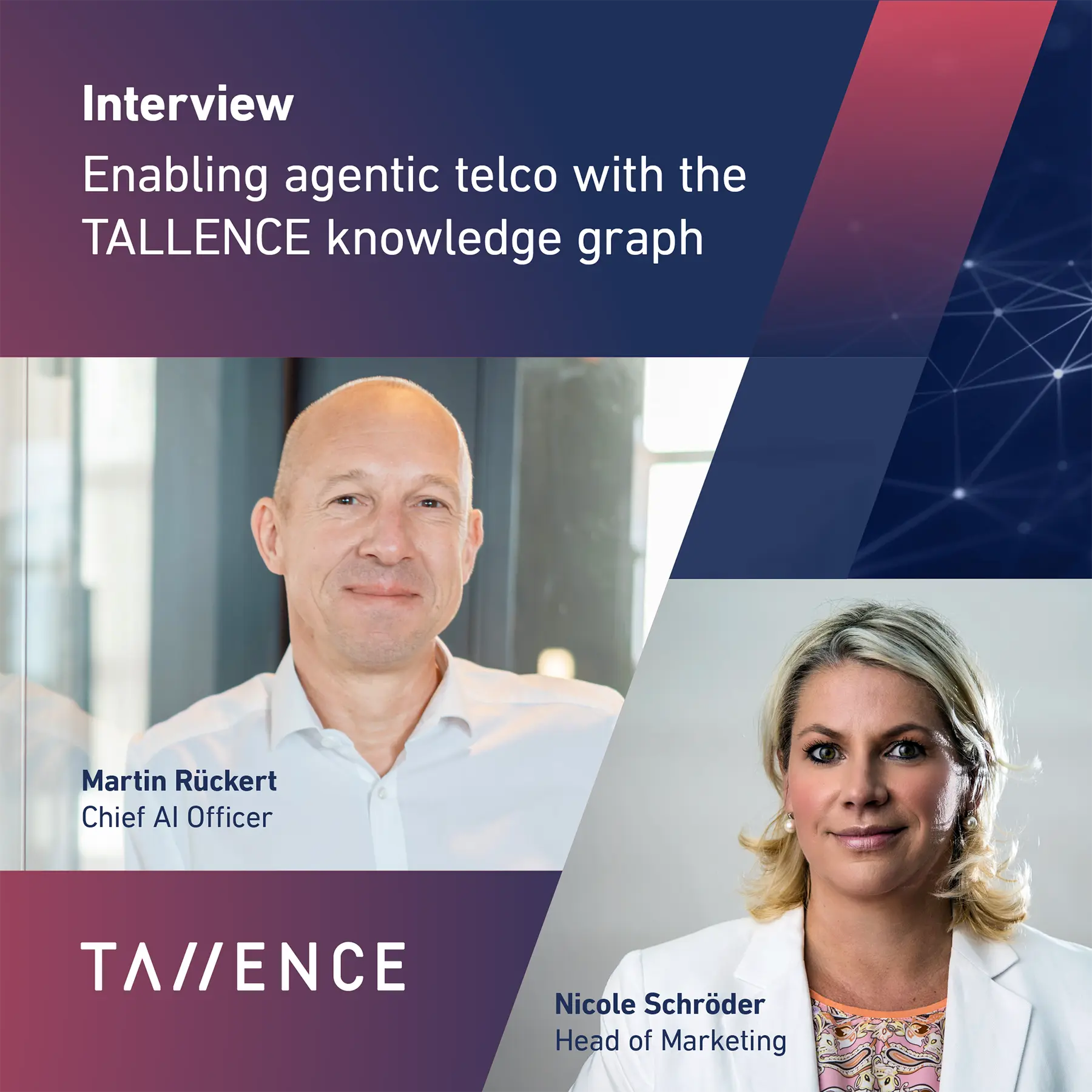
At Tallence, we translate that into one pragmatic question: How do you create shared operational understanding across OSS and BSS so AI can act reliably? Interview Partners Nicole Schroeder, Head of Marketing, Tallence AG Martin Rueckert , Chief AI Officer, Tallence AG
Why this topic at MWC - why now?
Nicole: Martin, MWC26 sets the stage with “The IQ Era.” What’s the biggest blocker you see when telcos try to turn that promise into operational reality?
Martin: The biggest blocker is missing shared understanding across domains. OSS sees network conditions like congestion, latency, packet loss. BSS sees customer impact like tickets, dissatisfaction, churn risk. But the linkage between those worlds is often weak. That separation creates blind spots, drives reactive operations, and slows down resolution and transformation.
The Tallence Knowledge Graph in one minute
Nicole: Give me the one-minute version for the MWC crowd: what is the Tallence Knowledge Graph?
Martin: It’s a living model of telco reality that maps entities - customers, devices, services, locations, network resources, historical events - and the relationships between them. This allows teams (and AI) to reason over context, not isolated fragments.
Systems of record vs. system of understanding
Nicole: Many operators hear “new platform” and worry about disruption. Is this a replacement story?
Martin: No, not at all. OSS and BSS remain the systems of record. The knowledge graph sits on top as a system of understanding - a semantic layer that connects network conditions to customer and business outcomes without forcing a big-bang replacement.
What changes in real operations?
Nicole: What does that enable in day-to-day operations and transformation?
Martin Three practical shifts. First, contextual intelligence: instead of reacting to isolated alarms or tickets, you can see the story across users, services, locations, and network resources. Second, AI alignment: graphs are naturally compatible with LLMs and agents because they provide structured, queryable operational context. Third, explainability: insights can be traced through relationships in the graph, which is critical for governance and trust.
“Agentic telco” without buzzwords
Nicole: Your blog uses the phrase “agentic telco.” What do you mean- in concrete terms?
Martin: It means moving beyond dashboards and manual firefighting toward workflows where AI can support decisions and actions based on real operational context. In the blog, we describe directions like predictive incident prevention, resource allocation, and QoS optimization driven by patterns in the graph - always grounded in relationships, not guesses.
Where to start, realistically
Nicole: If an operator says, “This sounds big - where do we start without boiling the ocean?”
Martin: Start with one high-value decision bottleneck that sits between OSS and BSS. Typical starting points are: connecting network events to customer impact, accelerating root-cause analysis by linking evidence across domains, or improving prioritization by understanding which services and customers are affected. Prove value with one flow, then expand.
Why this matters specifically in the IQ Era
Nicole: Bring it back to MWC26. How does this connect to “The IQ Era” message?
Martin: The IQ Era implies intelligence embedded into infrastructure and operations. But intelligence can’t be reliable if it’s blind to dependencies between network reality and customer reality. The knowledge graph creates shared operational understanding - that’s what makes AI-driven operations actionable, governable, and explainable.
Closing takeaway
Nicole: One sentence you want telco leaders to take away from MWC.
Martin: AI in telco becomes valuable when it’s grounded in shared understanding across OSS and BSS - and a knowledge graph is a pragmatic way to build exactly that.

// Contact
Nicole Schröder
Tallence at MWC:
We’re in Barcelona by appointment only, and our schedule is largely booked. If this topic is relevant for you, reach out anyway - if we can’t fit a slot during MWC, we’ll schedule a focused deep dive immediately after the event.