Skip content

TALLENCE AG • BRAND REPORT

»The value of AI lies not in the technology, but in its application.«

Highlights, Tech // Tallence Editorial Team // Oct 29, 2026
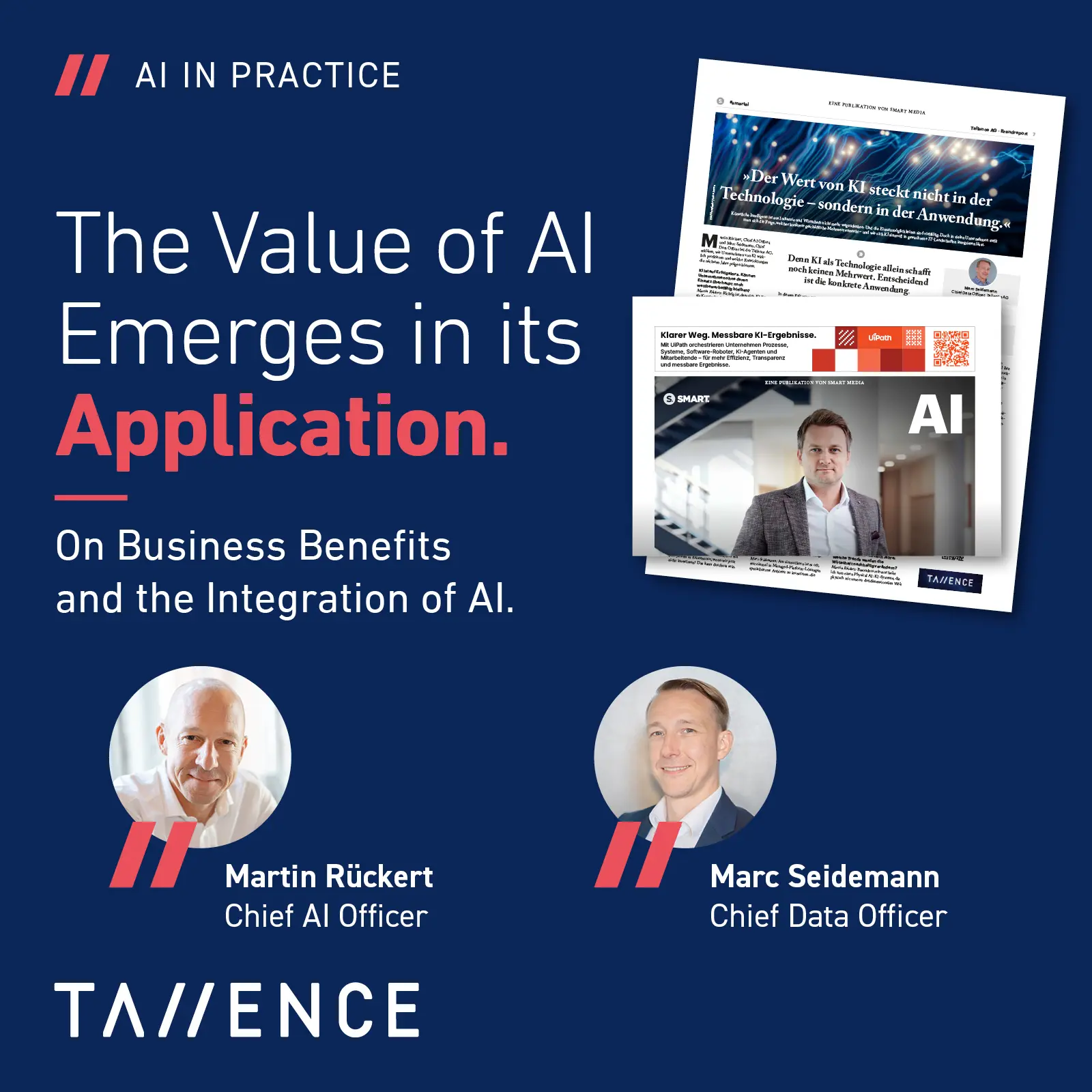
2026 10 Website Blog Post Handelsblatt 1200x1200px MARR 1119 engl

Artificial intelligence has become an integral part of industry and business, with a wide range of potential applications. Yet many companies are asking what tangible business value it delivers - and how it can be effectively integrated into established IT environments. Martin Rückert, Chief AI Officer, and Marc Seidemann, Chief Data Officer at Tallence AG, explain how companies can truly benefit from AI and which developments could shape the coming years.

Publication note: This interview with Martin Rückert and Marc Seidemann was originally published in German in the AI supplement produced by Smart Media and distributed with Handelsblatt. The English translation was prepared by Tallence.

AI continues to gain ground. Can companies remain competitive without using it?

Martin Rückert: AI has clearly established itself as a core technology. The question is therefore no longer whether to use it, but where it can make a meaningful difference. AI technology alone does not create value. What matters is how it is applied.

Marc Seidemann: Not every company needs to introduce as many AI applications as possible at full speed. Decision-makers need to connect AI initiatives with the challenges their businesses already face. Keeping operating costs in view and finding practical answers to the question of compatibility with legacy systems puts them on the right track. Long release cycles are another clear challenge. What matters is identifying where AI can deliver strategic value — within a reasonable timeframe and at a viable cost.

What is the best way to approach this?

Martin Rückert: In parts of industry, AI is still treated as a hype-driven topic. Everyone feels pressure to act. Teams are assembled and consulting projects launched, but that alone does not create value. Without a concrete use case, leaders should first establish a business case. They also need the right people, which is not always straightforward given the shortage of skilled professionals. This raises a different question for those responsible: how do we prevent AI ideas from turning into poor investments?

Marc Seidemann: A company often operates hundreds of systems, many of them legacy, alongside a range of different data sources. At the same time, it faces substantial technical debt. Operating costs are rising, skilled professionals are scarce, and investors expect rapid results, even with limited budgets. AI therefore needs to be integrated into a complex reality. That is why the starting point should be the specific problem to solve. Could the company’s survival be at risk in a few years if we do not invest now? That is certainly possible. If so, timely action is essential. Will using AI generate revenue or save money? In either case, we should act. But if the answer to all three questions is “no”, we would be well advised to let the hype settle first.
How do you select the “right” projects?

Martin Rückert: The key is to treat AI as an investment decision. We assess three dimensions: what tangible economic value does a project offer? How realistically can it be implemented using current AI technology? And how ready are the data, systems and IT infrastructure? Together, these provide a sound basis for deciding the order of implementation. The aim is to prioritise use cases where value and feasibility align, reducing the risk of an AI project being discontinued after a few months because it fails to deliver sufficient business value.

What do you need to make that decision?

Marc Seidemann: Data is a central prerequisite, but it is not the only one. As outlined earlier, AI is not being introduced into a greenfield environment. It needs to be integrated into an existing IT landscape, including its security requirements, interfaces and requirements for stable operations. That is why we look beyond the AI model to the entire chain supporting it: systems, processes and operational readiness.

What does Tallence’s collaboration with its customers look like in practice?

Martin Rückert: As a technology and transformation partner, we begin by assessing the current situation and use the findings to develop a concrete, testable AI use case. We aim to represent a clearly defined part of a problem in enough detail to assess the technology’s actual value. Once technical feasibility and economic value have been demonstrated, the focus shifts to integration into existing systems and scaling.

Marc Seidemann: Often, the most sensible first step is to invest in managed platform solutions from specialist providers that do not require extensive changes to the IT landscape. Our approach with THOR Voice AI is one example. It enables telecommunications companies to launch voice AI offerings that create services they can bill their customers for directly.

Are you also exploring new business models?

Marc Seidemann: Absolutely. For product platforms such as THOR Voice AI, we have deliberately moved away from traditional licensing and maintenance models. Our customers purchase capacity, and we share in the successful use of the solution. For customers, this means a lower proportion of fixed costs and a stronger link to actual usage.

Automation often raises fears of job losses. How do you bring employees on board?

Martin Rückert: These concerns are understandable, but so far we are not seeing AI replace people on a large scale. Instead, AI should complement the work of specialists and enable them to focus more on demanding, value-creating tasks. Agentic coding, for example, is about giving developers tools that help them work faster and increase throughput. The same applies to real-time translation or AI agents that capture and document information.

Looking five to ten years ahead, which trends will have a lasting impact on business?

Martin Rückert: One area I consider particularly relevant is Physical AI: AI systems that interact physically with our three-dimensional world. Instead of simply displaying answers on a screen, Physical AI perceives its surroundings through cameras, lidar or pressure sensors, for example, and translates that information directly into mechanical movements. This makes it fundamentally important for robotics and industrial applications. World models will also become increasingly relevant. They predict how a scene changes when specific actions are taken or physical laws come into play. World models serve as virtual simulation and training environments for machines.

Wagen wir einen Ausblick auf die nächsten fünf bis zehn Jahre: Welche Trends werden die Wirtschaft nachhaltig verändern?

Martin Rückert: Besonders relevant halte ich zum einen Physical AI: KI-Systeme, die physisch mit unserer dreidimensionalen Welt interagieren. Statt nur Antworten auf dem Bildschirm auszugeben, erfasst Physical AI ihre Umwelt etwa über Kameras, Lidar oder Drucksensoren und wandelt dieses Wissen direkt in mechanische Bewegungen um. Dies ist folgerichtig für Robotik und industrielle Anwendungen von elementarer Bedeutung. Stark an Relevanz gewinnen werden auch World Models, die vorhersagen, wie sich eine Szene verändert, wenn bestimmte Aktionen ausgeführt werden oder physikalische Gesetze wirken. World Models dienen als virtuelle Simulations- und Trainingsumgebung für Maschinen.

Tallence brings 25 years of experience in AI development. What does that mean for your customers in Germany, Austria and Switzerland?

Marc Seidemann: AI did not first appear on our agenda with the current wave of hype. Our experts have been working on AI architectures and their technological foundations for around a quarter of a century. Above all, this experience helps us put current developments into perspective. We do not need to adopt every new technology simply because it is attracting attention. But we know how to help our customers create reliable value with AI and stay ahead technologically.

Download the complete supplement

Read the interview with Martin Rückert and Marc Seidemann on page 7 of the AI supplement published by Smart Media and distributed with Handelsblatt.

Download the AI supplement

// Contact

Marc Seidemann

  • Chief Data Officer

FROM AI IDEA TO BUSINESS CASE

Where Can AI Deliver Measurable Value for Your Business?

Have a specific AI use case in mind and want to assess its potential?

Talk to our experts about the business value it could deliver and the requirements your data, systems, and processes need to meet to make it work.