Hinweis: Dieser Blogbeitrag ist nur in englischer Sprache verfügbar
Chief AI Officer
Why monetising AI in telecom starts with the right infrastructure stack
Highlights, Tech // Martin Rückert (Chief AI Officer) // 14.04.2026
The telecom industry has made real progress on AI. Networks are smarter, operations more automated, customer interactions more intelligent. Yet one question remains stubbornly open: where is the revenue? The answer is not more AI. It is AI built on the right foundation - an infrastructure stack where data, automation, and customer-facing services are designed to work together and to be monetised from the start. As industry leaders gather at FutureNet World 2026 in London, the conversation is shifting from whether to adopt AI to how to turn it into measurable business value. Tallence will be there with a point of view focused on exactly this: how operators move from isolated AI pilots to scalable, revenue-generating services - and which layers of the stack need to be in place to make that shift real.
Hinweis: Dieser Blogbeitrag ist nur in englischer Sprache verfügbar
Most operators have launched dozens of AI initiatives over the last three years. From network optimisation to customer-service automation, the pilots are there. The revenue impact, in most cases, is not.
The bottleneck is not the technology. It is the architecture around it. AI that is not grounded in clean, connected data, not able to act across domains, and not exposed to customers through monetisable services tends to stay stuck in proof-of-concept mode. Every operator we speak with has capable models. Far fewer have the layers underneath and above them to turn those models into production services.
Moving from pilot to production is therefore not a tooling question. It is a question of which capabilities you build.
Three capabilities determine whether AI in a telco organisation generates revenue or stays trapped in experimentation. They build on each other, and none of them works in isolation.
1. The semantic foundation - Knowledge Graph
AI decisions are only as good as the context they operate on. In most operators, that context is fragmented across OSS, BSS, network, identity, fraud, and provisioning systems - each with its own schema, each with its own truth.
A telco Knowledge Graph connects these silos into a governed, AI-ready semantic layer. It gives every downstream system a shared understanding of what a customer is, what a service is, what a network element does, and how they relate. Without this foundation, AI produces answers that are locally correct but operationally wrong. With it, AI gains the context required for real-time operational intelligence across the full estate.
Read more on Telco Knowledge Graphs here.
2. The coordination layer - Multi-Agent Negotiation Framework (MANeF)
Context alone does not act. The next layer is an intelligent automation fabric that turns semantic understanding into decisions at machine speed.
This is the role of a Multi-Agent Negotiation Framework. Rather than centralising AI orchestration in a single monolith, MANeF deploys lightweight, domain-specific agents across network, billing, and operations. These agents negotiate with each other inside a governed decision space - defined by explicit business rules, policies, and escalation thresholds - to fulfil business intent end-to-end. The result is automated resolution of complex cross-domain decisions, SLA compliance that self-enforces without central bottlenecks, and a fully auditable trail for every outcome. In production, this has translated into significant reductions in MTTR and meaningful SLA improvements.
Read more on Autonomous Multi-Agent Frameworks here.
3. The experience and monetisation layer - Voice AI
Foundation and coordination are necessary, but they do not – on their own – generate new revenue streams. Revenue requires a customer-facing service - something operators can package, price, and sell.
Voice AI is the most immediate and most under-used opportunity for that. Most telecom platforms already carry millions of voice minutes every day, through IMS infrastructure that is already deployed, paid for, and trusted. The upgrade is not a replatforming programme; it is embedded intelligence inside the network layer. With THOR, Tallence extends voice and messaging with AI-powered, cross-media capabilities - without replacing the core IMS. The phone number stays. The intelligence behind it evolves. Voice AI is not a feature. It is a platform capability - and it turns one of the most commoditised assets in the operator stack into a programmable interface for premium, monetisable services.
Competitive advantage in telecom will no longer be defined by who has deployed AI. It will be defined by who has turned AI into scalable, monetisable services - and who controls the infrastructure stack on which those services run.
That means combining data, context, and automation into services customers can buy. It means treating voice, once the most commoditised asset in the operator stack, as the programmable interface of a new service layer. And it means executing with the precision of a product organisation, not the cautiousness of a research pilot.
Operators who invest in the full stack - foundation, coordination, experience - will define the next phase of telco transformation. Those who do not will continue to fund pilots that never reach production. The technology is no longer the question. Execution, and the architecture behind it, is.
We will be at FutureNet World 2026 in London (21–22 April, Intercontinental O2) with a leadership presence focused on exactly this conversation:
• Frank Moll, CEO
• Martin Rückert, Chief AI Officer
• Marc Seidemann, Chief Data Officer
A particular highlight: Martin will join the speaker programme on the panel
"Unlocking New Revenue Opportunities by Monetising AI and Digital Infrastructure"
on 22 April 2026 at 2:50 PM.
If you are attending, we would value the conversation - on how operators move from AI experimentation to real monetisation, scalable transformation, and autonomous, intent-driven operations.
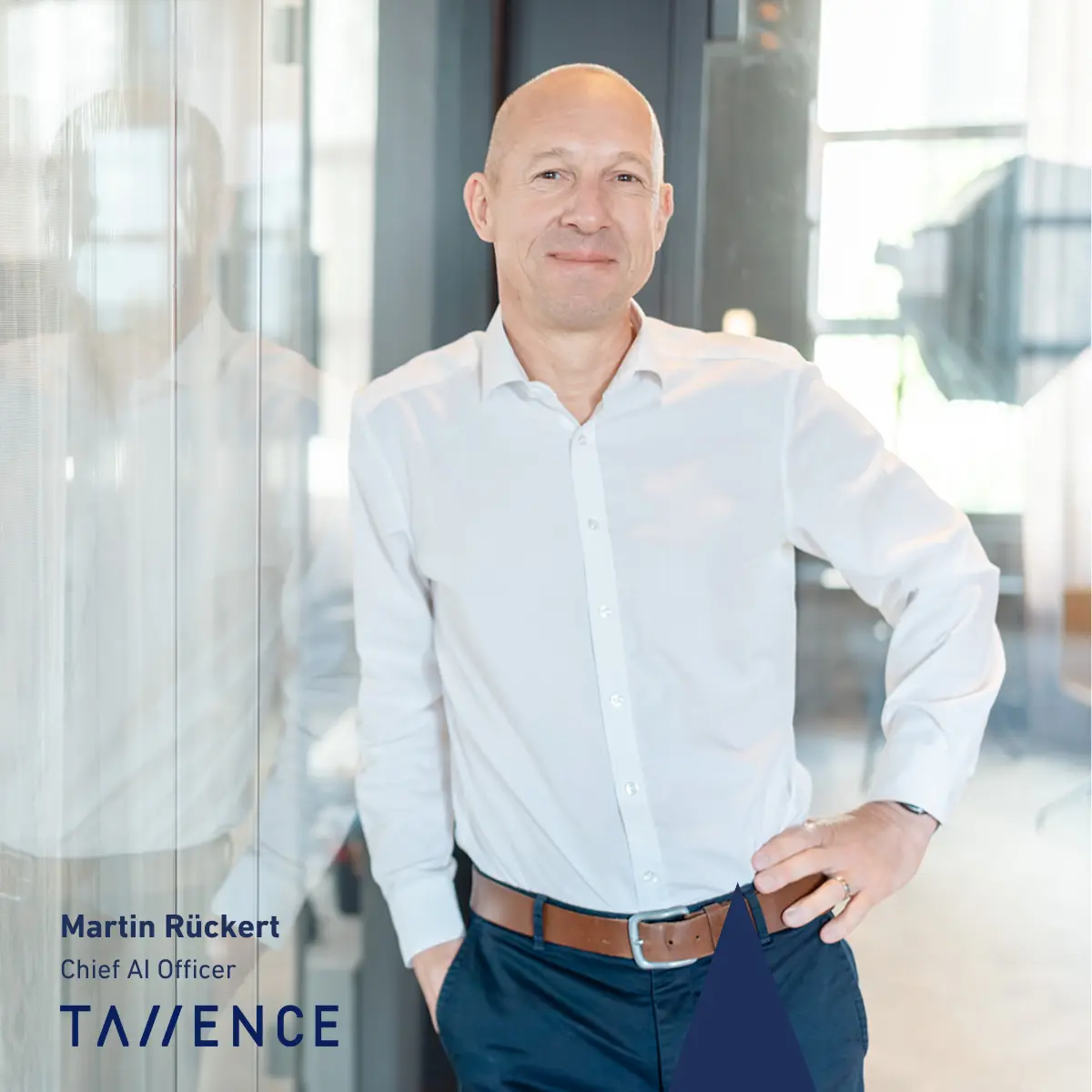
Martin Rückert is the Chief AI Officer at TALLENCE AG, where he leads the development of AI-driven products and agentic automation solutions for telecommunications operators. He has more than 20 years of experience in artificial intelligence, data platforms, and enterprise software, with leadership roles at Diamant Software, Market Logic, SAP, Salesforce, and IBM. Martin holds a U.S. patent in information systems and has contributed to publications on artificial intelligence and enterprise knowledge platforms. His work focuses on integrating AI into complex operational environments such as OSS/BSS to enable intelligent automation and AI-driven telecom services.

// Kontakt
Martin Rückert