Hinweis: Dieser Blogbeitrag ist nur in englischer Sprache verfügbar.
Chief Transformation Officer
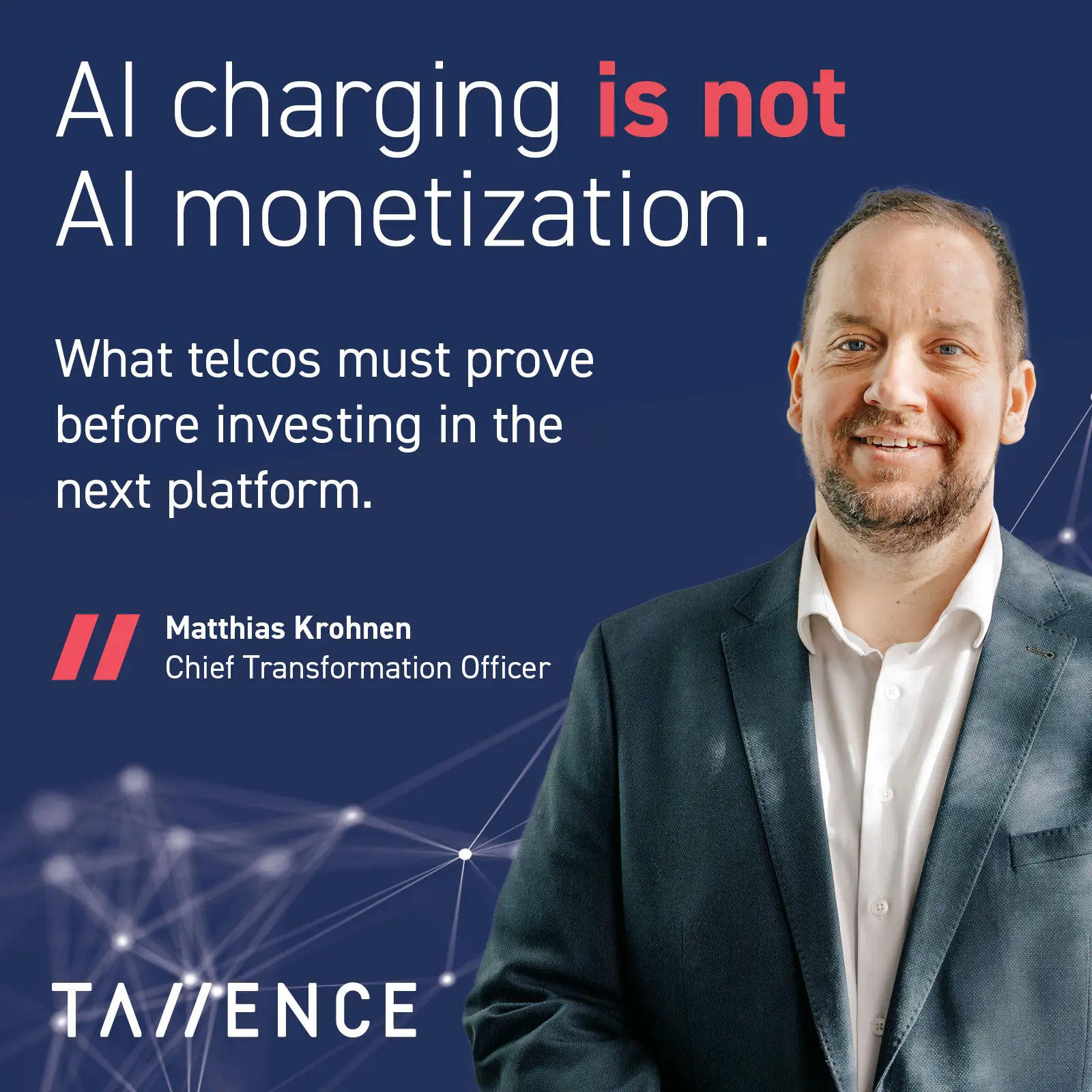
Artificial Intelligence is rapidly becoming the next strategic growth field for telecommunications providers. New platforms promise sovereign AI services, token-based charging and seamless integration into existing OSS/BSS environments. Yet technological readiness alone does not create a sustainable business model. In this opinion piece, Matthias Krohnen examines why successful AI monetization starts long before the platform is deployed. He argues that operators should validate customer demand, product-market fit and commercial viability before scaling infrastructure - and explains why the first question should not be how to charge for AI, but who is willing to pay for it.
Hinweis: Dieser Blogbeitrag ist nur in englischer Sprache verfügbar.
“This changes today,” says Bejoy Pankajakshan, Chief Technology and Strategy Officer at Mavenir, announcing the Integrated AI Platform his company has launched with Red Hat. Operators, the pitch goes, can now “monetize AI the way they already monetize data”: sovereign models on premises, policy-governed access to frontier models, token-accurate charging integrated into the existing BSS. Red Hat’s Chris Wright promises “a path from AI experimentation to AI monetization without rebuilding their operations model.”
It is an impressive platform. It is not yet a business.
Charging is a technical capability. Monetization is a commercial outcome. Between the two lies everything the announcement does not cover: customer demand, product definition, cost transparency, operational readiness, and sales execution. Operators should pursue the AI service opportunity – but they should resist building another major platform before proving the business it is expected to carry.
Enterprises increasingly need secure access to models and compute, and many face hard requirements on data sovereignty, auditability and regulatory compliance that make fully public, globally distributed AI services difficult to use for sensitive workloads. Operators run critical infrastructure under demanding service-level agreements, understand regulated environments and have decades of experience in identity, usage-based charging and high-availability operations. Research cited by Mobile Europe forecasts that telcos could generate more than $21 billion from GPU-as-a-Service by 2030, driven partly by enterprise compute demand and national AI-sovereignty requirements.
That number validates an industry narrative. It does not validate any individual operator’s business case.
A platform can offer model hosting, orchestration, token metering, zero-trust security and BSS integration. All necessary – but customers buy outcomes: a secure AI assistant for the contact centre, automated document analysis inside a regulated environment, an industry-specific agent connected to operational data. No enterprise signs a contract because the underlying stack runs on Kubernetes. It signs the business result, the price, the quality, and the accountability of the provider. Without a defined product, a named target customer and evidence of willingness to pay, an AI platform remains an investment hypothesis.
Follow the money on day one. When an operator builds a new AI platform, the software vendor gets paid, the GPU and hardware suppliers get paid, the integrators and model providers get paid. The operator’s own sequence starts with expenditure: licences, infrastructure, BSS integration, security and governance processes, product development and sales enablement – plus variable costs for external models and compute long before customer revenues reach meaningful scale.
The ecosystem has a defined product to sell to the operator. The operator still must work out what it will sell to the market. That does not make the investment wrong. It makes the operator the sole carrier of demand and utilization risk – a role the industry remembers from the edge-computing wave, when platform capacity was committed years before enterprise demand materialized.
Token-based charging meters consumption transparently and enables usage bundles, service tiers and enterprise contracts. What it does not answer is why a customer should buy AI services from a telecommunications provider rather than from a hyperscaler, a model company or a specialist sovereign-cloud provider. Four questions decide that. Why us – what does the operator offer that is hard to replicate? Why this service – which customer problem justifies a new contract and budget? Why now – what regulatory, operational or economic pressure makes adoption urgent? Why at this price – can the operator deliver competitively at an acceptable margin?
A generic AI assistant with telecom billing attached fails all four. A sovereign AI environment for a regulated industry – combined with identity management, policy enforcement, managed operations and contractual accountability – can pass them. The difference lies not in the charging unit but in customer value.
The conventional sequence of major transformation programs should be reversed: use case first, anchor customer second, operating model third, platform scale fourth. Identify a problem for which the operator has a defensible right to win. Validate it with real customers, ideally with commercial commitment. Design the end-to-end operating model – technology, partners, data governance, FinOps, service management, charging, sales and support. Only then scale the shared platform capabilities needed to serve multiple products. This does not slow innovation. It prevents heavy investment in capabilities that remain underutilized.
The economics must be equally explicit. AI costs move with model selection, token consumption, GPU utilization, latency requirements and service levels; a service that looks profitable in a controlled pilot can turn loss-making when usage patterns shift or external model prices rise. FinOps cannot be retrofitted after launch. Without cost-per-inference transparency, an operator can generate AI revenue and still fail to create AI profit.
The ambition behind the Mavenir–Red Hat platform is credible, and operators hold assets that matter in the AI economy: trusted infrastructure, customer relationships, regulated operations, identity and billing. But assets only become an advantage when they are assembled around a problem the market is prepared to pay to solve. Platforms for token charging, sovereign hosting and AI service assurance are enablers – not proof of monetization.
“This changes today”? It changes the day the first anchor customer pays. The next platform investment should begin with a validated service business, not with the technical ability to issue a bill.

// Kontakt
Matthias Krohnen
Building an AI platform is one thing. Building a profitable AI business is another.
If you are evaluating sovereign AI services, AI-enabled business models or the commercial foundations for AI monetization, our experts are happy to discuss your challenges and explore practical approaches together.