Hinweis: Dieser Artikel ist ausschließlich auf Englisch verfügbar.
Chief AI Officer
The context gap
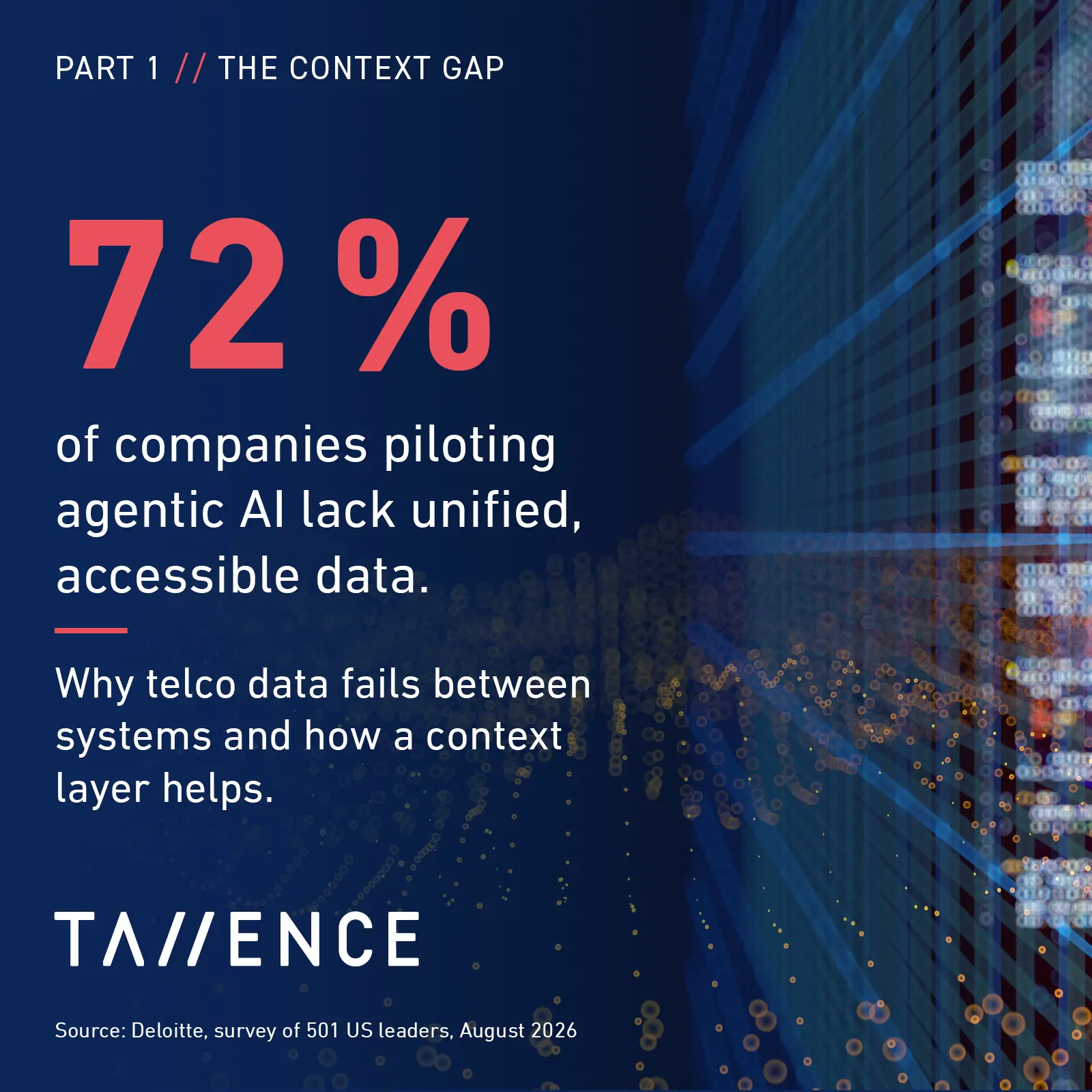
AI agents are increasingly expected to make decisions across organisational boundaries. But what happens when the data they rely on is fragmented, inconsistent or simply missing? A recent Deloitte survey suggests that most companies are still struggling with this problem. The question is whether better AI models alone can solve it, or whether we need to rethink how we connect and understand enterprise data.
Hinweis: Dieser Artikel ist ausschließlich auf Englisch verfügbar.
There is a Deloitte survey of 501 senior managers, up to C-suite level, in which 72% of respondents say they lack unified, accessible data. 67% say that it’s too costly and too complex. 42% rate their data foundation as prepared or highly prepared. 15% have scaled orchestrated multi-agent adoption.
What you can see from that number hierarchy is that, all in all, there is agreement among the respondents that they lack unified, accessible data. At the top end, 15% say they have scaled orchestrated multi-agent adoption. Now the question is: How did these 15% scale orchestrated multi-agent adoption in the absence of unified, accessible data? In purely mathematical terms, that could mean that those 15% do have unified, accessible data, but that is where I have my doubts.
THE LEGACY CHALLENGE
Data accessibility programs, and specifically data unification programs, are nothing new. We see them in customer situations again and again, and they have been around for as long as I can remember. I started my career in the 2000s, and even back then we saw middleware projects where data was mapped from one schema or data model to another, and metadata was essentially mapped from one system to another. That only meant translating the data from one structure into another, not agreeing on what it actually meant.
Even worse, most of these projects did not dare to tackle the problem of what the ultimate truth of a certain statement was at a certain point in time. They were not even looking at the problem that it is hard to define what actually counts as a statement of fact in a company.
Also, the technical representations companies already have are numerous, but each of them was built for one purpose or one silo. ERP systems model data for their own domain: accounting in one module, inventory in another. Data warehouses model data multi-dimensionally in relational databases, which works well for reporting, but only for the figures someone defined up front. Master data management creates golden records for customers or products, but usually per domain. Data lakes collect everything in one place, but as raw files without a shared meaning. Data catalogs and business glossaries describe what the data means, but for humans to read, not for agents to reason over. Vector stores hold embeddings of documents (documents, or chunks of them, encoded as vectors in a space where similar meaning means close distance), which capture similarity and plausibility rather than explicit facts. Each of these is valid inside its own boundaries, but none of them represents what is true across the whole company. It’s really complicated to decide what the representation of that should be.
THE SEMANTIC LAYER
None of this has to be thrown away, but each representation answers a different question. A relational, multi-dimensional model tells you how much: the EBIT figure itself, aggregated correctly. Embeddings tell you what probably belongs together and where the context is. What is missing is a knowledge graph that tells you what is true, since when and according to whom, and that “EBIT” in controlling and “operating result” in the board deck are the same thing. So it is not either-or: you need all of them, with the knowledge graph as the layer that holds the truth.
ORGANISATIONAL SILOS
In, let’s say, the pre-agentic world, what we were trying to do was get the data inside one system clean. For instance, we were trying to get ERP data clean for a specific domain, such as accounting and controlling, or we were trying to get the data sorted out and cleaned up for, say, the product and inventory domain. We never really associated one with the other. There were hardly any programs that looked at how one data element maps to another in a totally different organizational domain, unless there was a specific use case.
That alone tells you that there is little incentive for departments or organizational silos to work across their respective boundaries and invest in, let’s say, cross-silo data normalization and data modeling projects. Also, for instance, at the end of every quarter or financial year, there needs to be, in most organizations, some reporting of what the financial result actually was. Since agents that work across silos and try to reason across several domains of a company have only existed for about maybe a year now in November 2026, I would say, the benefit of such a project has never really been clear, except in siloed or very specific use cases.
THE AGENTIC SHIFT
The requirement for unified data is, cross-organisationally, only coming up now. That means that only now do people recognize that agents work better when they have the complete perspective of more or less everything in the company. With the enhanced power and leverage you can have as an employee or as a manager inside a company today, where agents freely reason across all silos at once, only now do you see that it’s beneficial to give your agent a complete, true and unified basis for decisions at any point in time.
That is how we prompt our agents, right? We give them context, ask them to judge that context and then make a decision within a certain domain or within a certain role. However, what we expect agents to do magically in the background for us doesn’t reliably work. Roughly speaking, the way agents answer our questions still relies on a paradigm of search: send the question against a body of data, get the most relevant search results, and then generate the answer from those. What we ignore is that the “search results” might not even contain the most relevant fact for our question, because the query step simply did not find it relevant. It could also happen that the answer was generated from a context window that could not hold more information, because that window, which the agent reasons over, is limited in size. And it could happen that several conflicting facts were stated and the reasoning mechanism could not decide clearly which one was true. There are more reasons for failure in the absence of the data unification methods described above; this is just a shortened list of examples.
THE KNOWLEDGE GRAPH
We have made clear that unified data is not there yet for most of the survey respondents, and we can confirm that from our own work with customers in transformation and intelligent automation. There are organizational and technology-driven reasons for that, and they are good reasons. But it would be a sad answer to stop there.
The good news is that the part that made these projects so expensive in the past is the part that agents are good at today. Reading through data stores and documents, finding out that “EBIT” in controlling and “operating result” in the board deck are the same thing, proposing how one data element maps to another across silos: that used to be months of work for data engineers and project managers. Today, agents can extract these facts and map them into a semantic layer, and people only need to confirm what the agents propose. That layer, a knowledge graph, then sits between the original data and the agents and holds what is true, since when and according to whom.
WHERE TO START
And it doesn’t have to be the big data unification program of the 2000s again. You don’t need to model the whole company up front. You start where your agents already fail today: one domain, one set of decisions, the questions where answers come back inconsistent or simply wrong. You build the facts for that, and the graph grows with every next use case, because every new domain connects to what is already there.
I would say it is less a question of whether you need that layer and more a question of when you start building it. Agents are only as good as the basis we give them for their decisions, and search across silos will not get you there. I would not be surprised if the ones who really end up in the 15% are those who built this layer early. A good place to start is to actively test out where your agents currently guess instead of know, and this is the conversation we are having with our customers right now.

// Kontakt
Martin Rückert
VON KI-ANWENDUNGEN ZU VERLÄSSLICHEN ENTSCHEIDUNGEN
Verlässliche KI-Entscheidungen brauchen eine verlässliche Datengrundlage. Lassen Sie uns gemeinsam herausfinden, wo fehlende oder widersprüchliche Daten Ihre KI-Agenten heute einschränken und wie eine semantische Wissensschicht helfen kann.